Honeycomb Cardboard vs Corrugated Cardboard: What's the Difference?
Updated: Apr 17

When it comes to protective and structural packaging, honeycomb cardboard sheets and corrugated cardboard sheets are two of the most important materials in use across UK industry today.
Both are paper-based, recyclable and versatile — but they are built differently, perform differently, and suit different applications.
If you are choosing between honeycomb cardboard sheets and corrugated cardboard sheets for transit protection, pallet layering or product packaging, this guide covers everything you need to make the right call.

What is honeycomb cardboard?
Honeycomb cardboard — also known as honeycomb paperboard, honeycomb board or honeycomb kraft paper — is a structural material built around a core of hexagonal paper cells sandwiched between two flat liner sheets.
The cell structure mimics a bee's honeycomb: rows of six-sided tubes running perpendicular to the face of the panel.
That geometry is no accident. Hexagons are nature's most efficient load-distributing shape. When thousands of them are stacked vertically inside a panel, the result is a material that handles compressive, shear and bending loads exceptionally well relative to how little raw paper it actually uses — the core is typically 85–95% air by volume.
In the UK, honeycomb cardboard is sold as flat sheets, rolls, pallet layer boards, edge protectors and bespoke fabricated components.
RhinoPack's own RhinoBoard is a fantastic example, available in a range of cell sizes and thicknesses to suit different load requirements.

What is corrugated cardboard?
Corrugated cardboard is the material most people picture when they think of a cardboard box. It consists of one or more layers of fluted (wavy) paper — the medium — bonded between flat kraft paper liners. The flute runs in parallel arches, giving the material its characteristic ridged cross-section.

Standard single-wall corrugated cardboard sheets (one fluted medium, two liners) are by far the most
widely used packaging material in the world.

Double-wall and triple-wall grades add further fluted layers for heavier-duty applications. Flute sizes — designated A, B, C, E and F — range from tall cushioning arches to tight, printable microflutes.

Corrugated cardboard is the backbone of almost all shipping boxes, postal mailers, picture frame packaging, bottle carriers and industrial containers.
It is widely stocked, competitively priced and compatible with high-speed automated packaging lines.
Honeycomb cardboard vs corrugated cardboard: key differences at a glance
Criterion | ||
Core structure | Hexagonal paper cells — load distributed in all directions | Parallel fluted waves — strongest along the flute |
Strength-to-weight ratio | Very high — exceptional compressive performance per gram | Good — strongest parallel to flute; weaker across it |
Compressive load capacity | Excellent — cells engage simultaneously in all lateral directions | Good (parallel); significantly lower (perpendicular) |
Typical weight per m² | 800–1,200 g/m² for a 20–30 mm panel | ~500 g/m² single-wall; 1,600+ g/m² triple-wall |
Thickness range | 10 mm – 100 mm+ | 3 mm – 16 mm (single to triple wall) |
Surface printability | Liner printable; not a standard print substrate | Excellent — standard for branded retail packaging |
Recyclability | 100% paper-based; fully recyclable | 100% paper-based; widely recycled |
Moisture resistance | Low standard; coated grades available | Low standard; wax/wet-strength grades available |
Best for | Pallets, transit boards, edge protection, protective panels | Boxes, mailers, displays, shipping containers |
Typical cost | Higher unit cost; savings come from weight reduction | Lower unit cost; commodity pricing widely available |
Strength and compressive performance
Honeycomb cardboard is typically stronger than corrugated at equivalent weight.
The key phrase there is "at equivalent weight" — this is where the comparison gets most interesting for engineers and procurement teams.
Corrugated cardboard has fluted arches which create a strong column structure parallel to the flute direction. Stack boxes with the flutes running vertically and they resist stacking loads effectively.
Rotate them 90° and that strength advantage largely disappears — corrugated is anisotropic, meaning its properties vary significantly depending on direction.
Honeycomb cardboard sheets by contrast, are quasi-isotropic in-plane. The hexagonal cells form a network that distributes compressive load across cell walls in every lateral direction simultaneously.
A 25 mm honeycomb panel engages hundreds of cell walls at once, which is precisely why it performs so well as a pallet layer board or heavy-duty transit panel.
For boxes and cartons — where creasing, folding and gluing on automated lines matters — corrugated cardboard wins on practicality.
It scores and folds predictably and can be die-cut into complex shapes. For flat protective panels, pallet layers and void-fill boards, the honeycomb board advantage is hard to match.
Buyer's watch-out: Some suppliers quote corrugated strength based on Edge Crush Test (ECT) values measured parallel to the flute.
Always confirm the orientation your boxes will be stacked in — off-axis loads are considerably weaker.
Honeycomb panels are much less sensitive to this effect.
Weight and material efficiency
Weight has two direct consequences in packaging: transport cost and material consumption. On both measures, honeycomb cardboard holds a clear advantage over corrugated when protecting the same payload.
A 25 mm honeycomb transit board weighs roughly 1.0–1.2 kg/m². A triple-wall corrugated sheet of equivalent structural thickness would weigh two to three times more.
That gap compounds at pallet scale: replace four wooden or corrugated layer boards with honeycomb boards and you can remove 8–12 kg from every pallet — meaningful savings on outbound freight and on the carbon cost of shipping packaging material itself.
This is one reason honeycomb paper board has grown rapidly as an alternative to wooden dunnage and heavy corrugated insert boards.
It delivers comparable load-bearing performance at a fraction of the weight, with no splinters, no phytosanitary treatment requirements for export shipments, and full recyclability at the destination.
Corrugated cardboard is efficient too — the flute layer introduces a high air fraction — but its directional constraints mean you often need extra material to compensate for off-axis weakness. Honeycomb's in-plane isotropy means more structural work done per gram of paper.

Sustainability and recyclability
Both honeycomb board and corrugated cardboard share a fundamental sustainability advantage over most packaging alternatives: they are 100% paper-based, biodegradable and widely accepted in standard cardboard recycling streams.
Neither requires chemical treatment, foam additives or plastic lamination in their standard forms.
That said, there are meaningful differences worth understanding:
Material consumption: Honeycomb uses significantly less paper per unit of structural performance. The high void fraction means you are mostly shipping geometry rather than raw material — a leaner environmental footprint per pallet protected.
Replacing non-recyclable alternatives: Both materials are increasingly specified as replacements for expanded polystyrene (EPS), polyurethane foam and solid wood dunnage.
Honeycomb's strength profile makes it especially suitable as a direct wood or foam replacement in heavy protective applications.
For more on this, see our guide to eco-friendly alternatives to bubble wrap and wood packaging alternatives with RhinoBoard.
Supply chain carbon: A honeycomb pallet layer saving 3 kg per pallet, shipped on 10,000 pallets per year, removes 30 tonnes of freight weight from your supply chain — reducing fuel consumption and transport emissions annually.
Recyclability in practice: Both materials enter standard paper and cardboard recycling. Some corrugated grades with wax or plastic coatings are not recyclable — always check the grade specification before making sustainability claims.
Best applications: where each material excels
Where honeycomb cardboard excels
Structural Pallet layers. extra cushioning and extra strong transit boards: The most common industrial application.
Honeycomb boards sit between product layers on a pallet, distributing weight and preventing damage from compressive loads and shock.
Available from RhinoPack in standard and custom formats at rhinopack.co.uk/honeycomb-cardboard-pallet-manufacturer.
Edge protection: Thick honeycomb strips absorb corner and edge impacts during transit, protecting goods from compression and fork-tine damage.

Artwork and print transit: Stiff, flat and lightweight — an excellent internal protective layer for artwork boxes and print mailers where rigidity is needed without excessive added weight.

Large picture frame packaging: Corner protectors and full-frame corrugated boxes provide a practical solution for large and heavy framed prints and mirrors. See boxes for large picture frames.


Bottle and glass packaging: Honeycomb cell dividers and cushioned wraps are proven protection for fragile goods. RhinoPack's glass bottle packaging uses strong corrugated grades for this purpose.

Foam and plastic replacement: Honeycomb void-fill panels can replace EPS inserts in many applications, maintaining protection while eliminating non-recyclable waste. See our guide to eco-friendly cardboard boxes for sustainable industrial packaging.
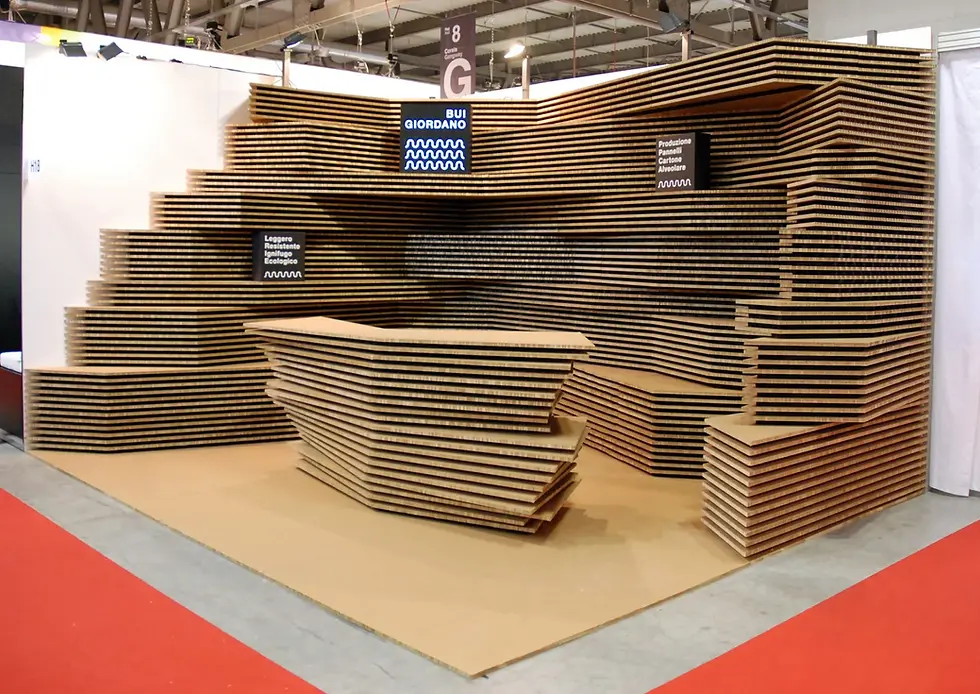
Lightweight structural panels: Used in furniture, exhibition stands, automotive packaging and architectural interiors where stiffness-to-weight matters.

Where corrugated cardboard excels
Shipping boxes and cartons: Corrugated is the undisputed standard. It creases, folds and glues on automated lines at very high speeds and is available in an enormous range of configurations. Bespoke corrugated boxes can be produced in almost any shape.

Photo and print mailers: Rigid corrugated mailers can be made from both variats including honeycomb. They protect flat items reliably and cost-effectively. See RhinoPack's photo print mailers.

Retail and branded packaging: Corrugated's printable outer liner makes it the go-to choice for branded unboxing experiences and point-of-sale displays.

Cost: unit price vs total packaging cost
On a pure unit-cost basis, corrugated cardboard is cheaper. It is one of the highest-volume manufactured materials in the world and benefits from enormous economies of scale.
Standard corrugated sheets and boxes are commodity items available from many suppliers.
Honeycomb cardboard carries a higher unit cost for the same surface area.
The manufacturing process — expanding and bonding the honeycomb core, then laminating the liners — is more involved than corrugated production.
However, total cost of packaging is the right metric for most buyers:
Weight savings: Lighter packaging reduces outbound freight costs, often exceeding the material price premium within 6–12 months at typical volumes.
Damage reduction: Better protection reduces damage claims, replacements and returns — particularly significant for high-value goods.
Material consolidation: A single honeycomb pallet board can replace a wooden layer board, foam edge protection and a corrugated void-fill panel simultaneously, reducing SKU complexity and total spend.
Regulatory compliance: As the UK's Extended Producer Responsibility (EPR) regime tightens, lighter and fully recyclable packaging will carry lower compliance levy costs.
For volume pricing on both materials, contact the RhinoPack team.
Which should you choose?
The answer depends on what you are packaging, how it moves through your supply chain, and what trade-offs matter most to your business.
Choose honeycomb cardboard if you need to protect heavy or fragile goods in transit without adding significant weight. If you are replacing wooden dunnage, foam inserts or corrugated layer boards. If you need a fully recyclable, paper-based solution with high compressive strength. If you are shipping internationally and want to avoid wood packaging regulations. See our full guide to strong cardboard boxes for heavy-duty items for more context.
Choose corrugated cardboard if you are manufacturing boxes or cartons at speed on automated lines. If you need a printable outer surface for branding or retail presentation. If your volumes are very high and lowest unit cost is the primary driver. If you need die-cut, folded or glued structures in complex shapes.
In many real-world supply chains, both materials appear within the same packaging system — corrugated outer cartons with honeycomb internal boards, or corrugated mailers with honeycomb edge protection strips. They complement each other rather than simply competing.
RhinoPack products: honeycomb and corrugated in stock
RhinoPack supplies both honeycomb board and corrugated cardboard from stock and to bespoke specification across the UK. Key products relevant to this comparison:
Not sure which product suits your application? Contact the RhinoPack team with your dimensions and load requirements.
Frequently asked questions
What is the main difference between honeycomb cardboard vs corrugated cardboard? Honeycomb cardboard uses a hexagonal cell core between two flat liners, distributing load in all lateral directions simultaneously. Corrugated cardboard uses a wavy fluted medium between flat liners, strongest parallel to the flute direction. Honeycomb delivers a higher strength-to-weight ratio; corrugated is more readily formed into boxes and cartons.
Is honeycomb cardboard stronger than corrugated?
At equivalent weight, yes. The hexagonal geometry distributes load across thousands of cell walls at once.
Corrugated is strong in one direction but loses performance significantly when loaded off-axis.
Which is more eco-friendly — honeycomb board or corrugated cardboard?
Both are 100% paper-based and fully recyclable.
Honeycomb uses less raw material per unit of structural performance (the core is mostly air), and its lower weight reduces transport emissions.
Both are far superior to EPS foam, plastic dunnage or solid wood from a recyclability standpoint.

Can honeycomb cardboard replace wooden pallets?
Honeycomb boards work well as lightweight pallet layer boards, replacing solid wood top-caps and base sheets.
They handle typical pallet stacking loads while being significantly lighter and fully recyclable. See our guide to wooden pallet alternatives.
Where can I buy honeycomb cardboard sheets in the UK?
RhinoPack supplies honeycomb cardboard sheets and honeycomb pallet boards in standard and custom sizes across the UK.
Visit rhinopack.co.uk or see our guide on where to buy honeycomb cardboard sheets in the UK.
What is the difference between honeycomb paperboard and corrugated board?
The terms honeycomb paperboard, honeycomb kraft board, honeycomb panel and honeycomb cardboard sheet all refer to the same material — a paper-based structural board with a hexagonal cell core.
Corrugated board, corrugated cardboard and fluted board all refer to the parallel-fluted alternative. The structural difference between them is explained in full above.
Summary
The core distinction between honeycomb cardboard and corrugated cardboard comes down to structure and purpose.
Honeycomb board uses a hexagonal cell core to achieve an outstanding strength-to-weight ratio — making it the right choice for pallet protection, edge guarding and lightweight structural panels.
Corrugated cardboard uses a parallel fluted medium to create a material that is easy to fabricate, cost-effective and ideal for standard boxes, mailers and retail packaging. Understanding those structural differences is the key to specifying the right material for each application — and often, the smartest answer involves both.
For expert advice on whether honeycomb cardboard or corrugated cardboard is right for your packaging challenge, contact the RhinoPack team at rhinopack.co.uk/contact-us or browse the full product range at rhinopack.co.uk. Come join us - https://www.facebook.com/RhinoPack.co.uk
Or find us here -